Authors: Huiyi SONG | Chenxi GUAN
The Provisions of the State Council on Exit and Entry Administration (State Council Order No. 841, hereinafter "Order No. 841")[1] will take effect on September 15, 2026. Consisting of only 19 articles, the Provisions follow the principle of addressing the most pressing needs first and respond to the "new challenges and new issues" that have arisen since the Exit and Entry Administration Law came into force. According to statements made at a press briefing by officials of the Ministry of Justice, the Ministry of Public Security and the National Immigration Administration, this legislation is principally intended to fill in institutional gaps in three areas: the safety of Chinese citizens traveling abroad, the entry of foreign nationals, and the regulation of intermediary services. It also further strengthens scrutiny of the authenticity of stated grounds for applications and the verifiability of the relevant conduct[2].
In specific cross-border matters, Order No. 841 may apply in conjunction with rules on export controls, technology import and export, and data security. Read together with the previously implemented State Council Order No. 837[3] governing outbound investment and Announcement No. 21 of 2026 issued by the Ministry of Finance and the State Taxation Administration[4] concerning individual income tax on offshore trusts, this series of rules clearly reflects the current policy orientation of promoting standardization in the governance of going global and other cross-border activities. This article provides an in-depth analysis of Order No. 841 and examines its differing implications for six categories of persons.
Legislative Principles and Regulatory Positioning
I. Legislative Purpose
Article 1 of Order No. 841 expressly states that the Provisions are intended to regulate exit and entry administration, protect individuals' legitimate rights and interests, and safeguard national sovereignty, security and development interests. The new rules are not intended to tighten the movement of persons, but to balance openness and security.
II. Three Key Shifts
The new rules reflect three key shifts. First, they promote more refined administration through record-filing and authenticity review. Second, they connect technology export controls with compliance obligations for exit-entry personnel. Third, they strengthen risk management through measures such as intermediary record-filing, accountability for the accuracy of applications, and security advisories.
III. Scope of Application
Order No. 841 does not introduce a completely new exit-approval regime, nor does it directly modify the rules governing nationality, household registration, foreign exchange, taxation or overseas assets. Its regulatory focus is the authenticity of applications, cross-border technology transfers, identity inconsistencies, and intermediary services.
Practical Implications for Six Categories of Persons, and Compliance Considerations
I. Technical Personnel and Export-Control-Sensitive Enterprises
1. Rule Highlights
Article 4 of Order No. 841 adds a new rule: where a Chinese citizen has violated export-control, technology import and export administration or other applicable requirements[5], and may thereby endanger national industrial or technological security, the Ministry of Commerce and other authorities under the State Council may decide that the citizen shall not be permitted to leave China. Technology enterprises should pay particular attention to this provision.
The provision applies only where a Chinese citizen has committed a relevant violation and may endanger industrial or technological security. The decision is to be made by relevant authorities under the State Council and enforced by the immigration administration authorities. A person may not be restricted from leaving China solely by reason of his or her occupation or employer.
Article 12(5) of the Exit and Entry Administration Law already sets out the legal basis for exit restrictions[6]. Building on this framework, Order No. 841 further requires written notice of the facts, grounds, legal basis, and available remedies before an exit restriction is imposed. Matters involving national security or a criminal investigation are excepted.
2. Practical Implications
Enterprises should conduct a holistic assessment of the personnel, technologies, activities and counterparties involved. Key questions include: What information will be shared overseas? Who will have access to the relevant technologies or systems? Is any technology subject to export controls? Could cloud storage, remote access, oral communications, or portable devices constitute a cross-border transfer of controlled technology or data?
Particular attention should be paid to scenarios such as the relocation of a core team, employees joining overseas competitors, or a change of control involving the transfer of technological assets overseas. These scenarios should be assessed from multiple compliance perspectives, including export controls, technology import and export rules, cross-border data transfers, outbound investment, intellectual property, and employment matters.
3. Compliance Recommendations
Enterprises should integrate outbound travel into their export control compliance framework. Different categories of personnel—such as core technical staff, employees involved in sensitive projects, and those traveling overseas for routine business—should be subject to proportionate pre-departure controls, including written records and clearly defined information boundaries. Where employees plan to join an overseas competitor, take up a long-term overseas role, or participate in joint R&D after leaving the enterprise, advance compliance reviews should cover export controls, intellectual property, confidentiality, and cross-border data transfers.
Circumstances warranting particular attention include:
research and development personnel working in integrated circuits, artificial intelligence, biomedicine, aerospace, quantum technology and similar fields;
personnel employed in sensitive fields such as the defense industry, nuclear energy and national-defense science and technology; and
key technical personnel who possess core technical secrets or are deeply involved in internal export-control reviews.
Key technical personnel should confirm in advance whether the relevant technical content falls within a controlled scope and should retain records of that review.
II. Individuals with Cross-Border Assets and Multiple Identities
1. Rule Highlights
Under Article 9 of the Nationality Law of the People's Republic of China, a Chinese citizen who has settled abroad loses Chinese nationality automatically upon voluntarily acquiring a foreign nationality. This change takes effect by operation of law. Retaining Chinese identity documents or delaying household registration deregistration does not alter that legal position.
Using different identities inside and outside China has never been a lawful way to maintain separate identity statuses. The risks were simply harder to detect when identity verification mechanisms were less developed. Practices such as switching between Chinese and foreign identity documents, continuing to use a mainland Chinese identity after acquiring foreign nationality, or holding a foreign passport without a genuine connection to the issuing jurisdiction can give rise to significant compliance risks.
Order No. 841 materially narrows the scope for such practices at the regulatory level. It requires the grounds stated in exit and entry applications to be truthful and lawful, while empowering immigration and visa authorities to conduct inquiries and request relevant documents, materials, and electronic data. Electronic-data verification is one of the most substantive changes introduced by the new rules. Passport-use records, travel histories, and household-registration information may be cross-checked across different databases, making inconsistencies between a person's Chinese and foreign identities easier to identify.
2. Practical Implications
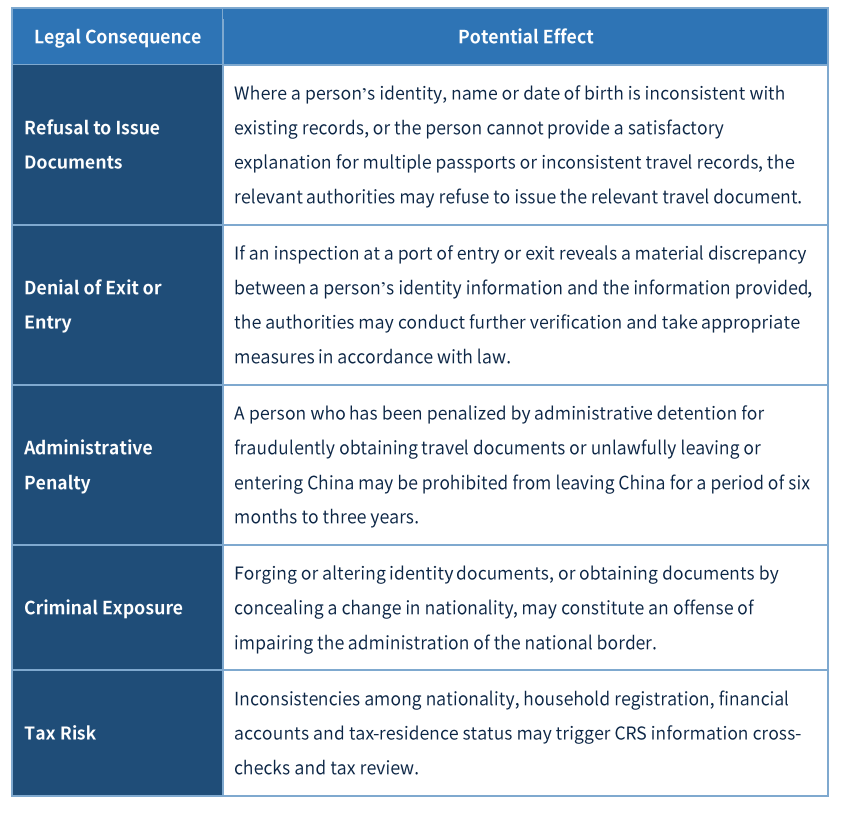
Inconsistent identity information can trigger consequences far beyond additional document requests. It may affect the issuance of identity documents and result in administrative penalties, criminal liability, or tax-related consequences.
(1) Legal Consequences of Identity Inconsistency
Article 3 of Order No. 841 requires applicants to provide truthful and lawful grounds for their applications and empowers the competent authorities to verify the applicant's identity and stated grounds in accordance with law. Identity inconsistency may result in the following consequences:
(2) Impact on Travel to and from China After Acquiring Foreign Nationality
Once a Chinese citizen acquires foreign nationality and subsequently enters China as a foreign national, the person becomes subject to the regulatory framework governing the entry of foreign nationals. The principal implications include the following:
Travel to and from China is governed by a different set of rules. Before acquiring foreign nationality, a person may travel to and from China using a Chinese passport or, where applicable, an Exit-Entry Permit for Traveling to and from Hong Kong and Macao, without needing a visa or being subject to a fixed period of stay. After acquiring foreign nationality, however, travel to China is generally subject to the rules applicable to foreign nationals. A visa may be required or, where visa-free entry is available, a prescribed period of stay will apply. Activities in China must also be consistent with the relevant visa or entry status. Long-term residence may additionally require a work permit and/or residence permit.
Existing assets and investments in China may also require adjustment. If real property, equity interests or bank accounts acquired while the person was a Chinese citizen have not been updated to reflect the person's foreign nationality, discrepancies between identity and ownership records may complicate subsequent transactions or regulatory procedures. For example, a real estate authority, bank or securities firm may require additional documentation before processing a sale, mortgage, inheritance matter or other transaction. In sectors subject to foreign investment restrictions, such as telecommunications, education and media, the acquisition of foreign nationality may also affect the applicable ownership or foreign-investment requirements and, in some cases, require the existing ownership structure to be adjusted.
Following a change of nationality, the requirements for visas to China, permitted periods of stay and business activities must be reassessed under the rules applicable to foreign nationals. The person may not continue to rely on his or her former status as a Chinese national.
(3) Legal Consequences Relating to Dual Nationality
China does not recognize dual nationality. Where Article 9 of the Nationality Law applies, a Chinese citizen automatically loses Chinese nationality upon acquiring foreign nationality, without the need for a separate declaration or application. The following are common misconceptions and the corresponding corrections:
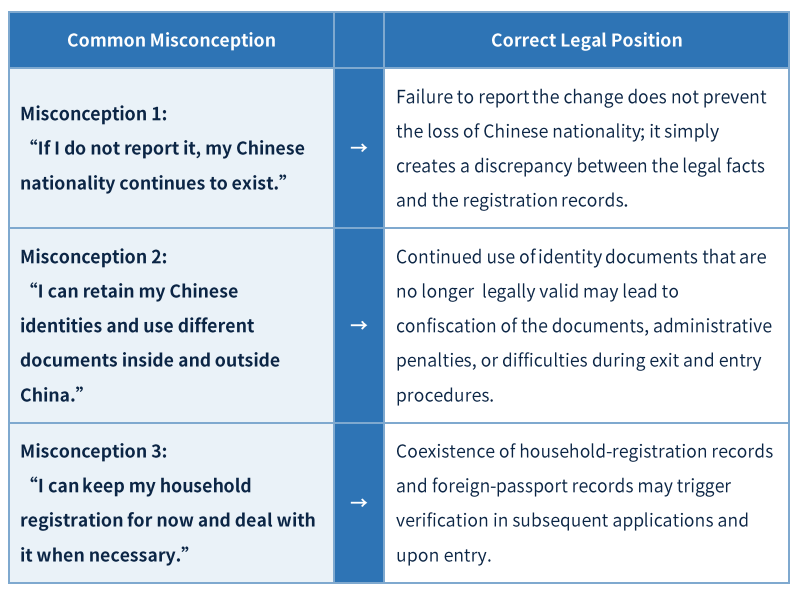
As cross-checking of identity, travel, tax, and financial information becomes more sophisticated, inconsistencies between a person's Chinese and foreign identities are increasingly likely to be detected. Continuing to use a Chinese-citizen identity after acquiring foreign nationality may give rise to risks relating to identity documents, border controls, and the management or disposal of assets in China.
3. Compliance Recommendations
Individuals should conduct a comprehensive review of existing identities, including current nationality and residence status, all historical documents, travel records, and their household registration records in China. A person who has acquired foreign nationality but has not deregistered their Chinese household registration or surrendered their Chinese passport should voluntarily report to the public security authority in the place of household registration and complete the relevant procedures in accordance with law.
Anyone holding a "backup passport" without a genuine residential connection to the issuing jurisdiction should relinquish that nationality and carefully assess the risks of continuing to use the passport, particularly in light of the authenticity checks under Order No. 841.
III. Public Officials, Military Personnel and Others in Sensitive Positions
1. Rule Highlights
Article 10 of Order No. 841 prohibits intermediary service providers from unlawfully assisting public officials, military personnel and other specified persons in obtaining foreign nationality, overseas residence documents, or other exit or entry documents. Where an intermediary identifies a violation, it is also required to report it. The obligation falls on the intermediary itself and is triggered by unlawful assistance. It does not mean that all public officials are categorically prohibited from leaving China, nor does it require intermediaries to report every interaction with a public official.
This provision links intermediaries' duties to identify, refuse to provide services to, and report such cases with the existing systems for the supervision of public officials, private travel abroad, and the management of relevant travel documents. Internal approval and document-custody procedures within an individual's employing organization are distinct from a formal exit restriction imposed by the competent authority and enforced by the immigration authorities, as they are governed by different legal bases and procedures.
The scope of "public officials" may be understood in light of Article 15 of the Supervision Law[7]. It generally covers civil servants and personnel subject to the Civil Servant Law, managers of state-owned enterprises, and persons entrusted with the administration of public affairs or otherwise lawfully performing public duties in public institutions. Whether an individual falls within this category should be determined primarily by the person's actual position and the nature of the public functions performed, rather than solely by the type of organization for which he or she works.
2. Practical Implications
Order No. 841 does not introduce a general requirement for public officials to obtain approval before leaving China. It does, however, make violations involving the acquisition of foreign nationality, permanent residence, or long-term residence status more likely to be detected. Such violations may result in removal from office or dismissal, and may also trigger liability for failing to report relevant personal matters or for unlawfully retaining documents.
Failure to obtain organizational approval or to return a document held in centralized custody is generally an internal administrative matter. An exit restriction enforceable at the border arises only when a competent authority, acting pursuant to law, has formally imposed the restriction and notified the immigration authorities. Conversely, approval by the person's organization does not prevent another competent authority from imposing a lawful exit restriction.
Order No. 841 does not automatically extend restrictions to identity applications made by relatives, including spouses and children. A genuine and independent application by a relative for overseas status is, in principle, governed by the ordinary rules. If the relative is also a person subject to special restrictions, Article 10 applies to that person separately.
For persons subject to personal-matter reporting obligations, a spouse's or child's relocation abroad, acquisition of foreign nationality or permanent residence, and related employment, investment and asset matters may be subject to reporting or review. The specific requirements depend on the category of personnel and the rules applicable to the relevant organization.
Where a relative is the nominal applicant but the source of funding, ultimate beneficiary, or actual residence arrangements point to the public official, or where a relative is used to hold assets on the official's behalf with the purpose of circumventing reporting requirements, intermediaries should look beyond the formal identity of the applicant and assess the underlying circumstances. A family relationship, without additional facts indicating proxy assistance, circumvention, or beneficial ownership, is not by itself sufficient to establish unlawful assistance.
3. Compliance Recommendations
Before undertaking private travel abroad or to Hong Kong, Macao or Taiwan, applying for overseas residence, or arranging family relocation, public officials should confirm the applicable requirements regarding registration, document custody, organizational approval, and reporting of personal matters. Personnel in sensitive positions, those with access to classified matters, or those who have not completed separation and handover procedures should complete the relevant internal procedures before taking such actions.
Where a spouse or child independently applies for overseas status, records should be retained regarding the purpose of the application, source of funds, responsibility for expenses and ultimate beneficiary. If the public official provides funds or participates in the arrangements, the parties should first assess whether any approval, reporting or recusal obligation is triggered.
Intermediaries should identify the actual principal, payer and beneficiary, and assess whether the service involves a public official or military personnel. Where an intermediary identifies an unlawful arrangement, it should refrain from further handling the matter, retain relevant records, and submit a report in accordance with the law.
IV. Individuals Subject to Exit Restrictions Due to Administrative Violations, Overseas Offenses, or Other Specified Circumstances
1. Rule Highlights
Order No. 841 sets out three categories of circumstances in which Chinese citizens may be subject to exit restrictions:
A person who has received administrative detention for fraudulently obtaining exit and entry documents or for unlawfully leaving or entering China may, upon a decision of the immigration administration authorities, be prohibited from leaving China for a period of six months to three years from the date on which the penalty has been fully enforced.
A person who has engaged in unlawful or criminal conduct abroad that endangers national security or interests may, upon a decision of a competent authority acting pursuant to law, be prohibited from leaving China for a period of six months to three years from the date of return to China.
Where a person has violated export-control or technology import and export administration requirements and may thereby endanger industrial or technological security, the competent commerce and other authorities under the State Council may decide to prohibit the person from leaving China. The provision does not prescribe a uniform fixed term.
Separately, providing false materials or making a false statement in an application may result in refusal to issue a document or denial of exit.
2. Practical Implications
The relevant authorities, commencement dates and applicable periods differ among the three categories. Providing false application materials does not fall within the categories of exit restrictions described above. Instead, it may result in refusal to issue the relevant documents or denial of exit.
3. Compliance Recommendations
A person who has previously been subject to an administrative penalty, undergone inspection at the border, or had an application for travel documents refused should, before undertaking significant travel, review the penalty decision, enforcement date, restriction decision and applicable period. Upon receiving an exit prohibition decision, the person should verify the decision-making authority, factual basis, legal grounds, duration and notice of available remedies. Statutory exceptions to notification apply in matters involving national security or a criminal investigation. Even after a measure has been lifted, the effect of the historical record on a subsequent application must be assessed in light of the specific matter.
V. Foreign Nationals and Former Chinese Citizens Following a Change of Nationality
1. Rule Highlights
Article 5 of Order No. 841 further refines the framework governing the entry of foreign nationals. The relevant restrictions may be summarized under three dimensions:
A foreign national who provides false materials or makes a false statement when applying abroad for a Chinese visa or applying for entry at a port may be prohibited from entering China for a period of one to five years.
A foreign national who has received criminal punishment for an offense of impairing the administration of the national border, or an administrative penalty for fraudulently obtaining exit or entry documents or unlawfully leaving or entering China, may be prohibited from entering China in accordance with law.
A foreign national who has been placed on a countermeasure list, the Unreliable Entity List or the Malicious Entity List, or who is subject to countermeasures or restrictive measures, may be refused travel documents or denied entry by relevant authorities.
A former Chinese citizen who has lawfully acquired foreign nationality and enters China in the capacity of a foreign national is subject to the rules governing the entry of foreign nationals.
2. Practical Implications
After acquiring foreign nationality, a former Chinese citizen should pay close attention to the transition from his or her former identity status. Failure to deregister household registration or surrender a resident identity card in a timely manner may create inconsistency between identity status and travel records. As discussed above, continued use of a Chinese resident identity card, passport or Exit-Entry Permit for Traveling to and from Hong Kong and Macao may trigger further verification.
Following the change in nationality, new investments in China, changes to corporate registration, or the disposal of certain assets may become subject to the rules applicable to foreigners. Existing assets do not automatically become invalid; however, sector-specific access restrictions, foreign ownership limits, and registration requirements may affect subsequent transactions involving those assets.
A change of nationality also does not automatically change tax-residence status. Inconsistencies among household registration, identity documents, financial accounts and tax-residence status may trigger CRS and tax review. Where an offshore trust is involved, Announcement No. 21 of 2026 issued by the Ministry of Finance and the State Taxation Administration should also be considered.
3. Compliance Recommendations
A person who has acquired foreign nationality but has not completed the necessary formalities in China should first confirm his or her nationality status, and then address household registration and Chinese identity documents in accordance with law. Financial accounts, business registrations and real-property registrations should each be reviewed to determine whether an update or change is required. Where the person holds equity interests in China or is involved in sectors subject to foreign-investment restrictions, the person should also assess applicable foreign-investment access requirements and potential restrictions on future transactions, while retaining naturalization records, historical application documents, and source-of-funds documentation.
Before traveling to China, the stated grounds for entry, travel documents, identity status in China and actual activities should be consistent. When an enterprise invites a foreign employee, director, adviser or counterparty to China, it should also conduct appropriate screening against relevant lists and review whether any prior restrictive measures apply.
VI. Exit and Entry Intermediary Service Providers and Their Personnel
1. Rule Highlights
Articles 7 through 13 of Order No. 841 establish an administrative regime for exit and entry intermediary services.
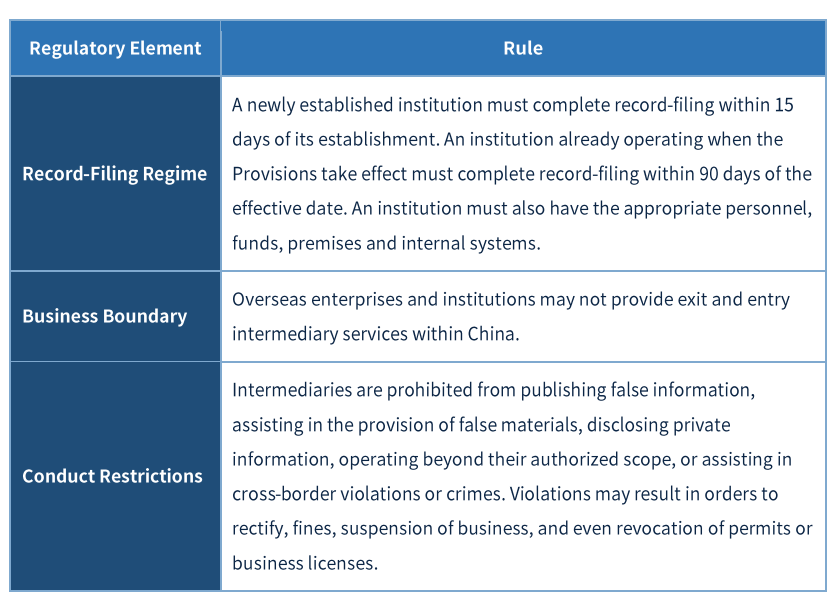
Non-profit general policy consultations and inquiries do not constitute intermediary services as defined in the Provisions. Although record-filing is not an administrative licensing regime, intermediary providers operating without proper filing or under inadequate compliance controls will face heightened compliance risks.
2. Practical Implications
Overseas enterprises and institutions may not provide the relevant intermediary services directly within China without proper establishment in China. Whether a service is provided within China should be assessed based on the substance of the activities, including where client acquisition, consultation, document collection, substantive processing, and personnel management take place, rather than merely the place of contract execution or payment receipt. Family offices and human resources institutions that assist with relevant procedures should likewise assess whether record-filing obligations apply.
3. Compliance Recommendations
Intermediaries should review their onshore and offshore service processes, participating entities and actual places of operation; confirm the scope of record-filing applicable to the institution and its personnel; and strengthen mechanisms for client onboarding, document authenticity verification, review of clients with special status, reporting, and personal information protection. Where clients are acquired in China but contracts are signed and fees collected offshore, the institution should determine whether its onshore team has substantively provided intermediary services.
Procedural Developments and Practical Outlook
I. Standardization and Coordination of Border Control Measures
Article 6 of Order No. 841 unifies the enforcement mechanism for exit prohibition decisions. The decision-making authority must notify the immigration administration authorities and, in principle, inform the person concerned in writing of the factual basis, legal grounds and available remedies. Matters involving national security or a criminal investigation are excepted. By bringing decisions made by different competent authorities into a unified enforcement procedure, this provision helps improve the standardization and predictability of border administration.
II. Extension of Cross-Border Compliance Review
Order No. 841 extends cross-border compliance review to the legal conditions for departing China. Where a person falls within a statutory circumstance, the authorities may refuse to issue a document or restrict the person from leaving China in accordance with law.
III. Practical Observations
1. The Differentiated Administration Regime Will Be Further Improved
Article 4 prescribes differentiated measures for different circumstances, providing a clearer administrative basis for matters such as administrative penalties and technology export controls.
2. The Intermediary Sector Will Enter a New Stage of Standardized Development
Record-filing and tiered penalties will raise compliance requirements for intermediary services. Direct operations in China by overseas institutions will be restricted, and consolidation within the industry may accelerate.
3. Technology Export Controls and Personnel Exit Management Will Become More Closely Coordinated
Article 4(3) links violations of export-control and technology import and export requirements with consequences for personnel exit. High-technology enterprises should accordingly improve their pre-departure technology compliance reviews for relevant personnel.
4. Enforcement Coordination in Relation to Foreign-Related Sanctions Lists Will Be Strengthened
Article 5 connects the relevant countermeasure and restrictive lists with document issuance and entry inspection. Foreign-related legal services should incorporate relevant screening into their routine compliance processes.
Conclusion
The promulgation of Order No. 841 represents an important step in strengthening the legal framework for China's high-standard opening-up while balancing development and security. The Provisions operate alongside the Exit and Entry Administration Law, the Nationality Law, and related rules on export controls, technology import and export, data, supervision, taxation, and foreign exchange. Together with Order No. 837, Announcement No. 21, and other regulatory measures, they form part of a broader cross-border compliance framework that reflects a continued shift toward more precise, coordinated, and law-based governance of foreign-related matters.
These developments emphasize the need for businesses and individuals engaged in cross-border activities to adopt a more integrated compliance approach covering identity, immigration, investment, technology, data, and tax considerations.
Important Announcement |
|
This Legal Commentary has been prepared for clients and professional associates of Han Kun Law Offices. Whilst every effort has been made to ensure accuracy, no responsibility can be accepted for errors and omissions, however caused. The information contained in this publication should not be relied on as legal advice and should not be regarded as a substitute for detailed advice in individual cases. If you have any questions regarding this publication, please contact: |
|
Huiyi SONG Tel: +852 6486 0307 Email: huiyi.song@hankunlaw.com |
[1] The full text of Order No. 841 is available at: https://www.gov.cn/zhengce/content/202607/content_7077172.htm.
[2] See the press briefing held by officials of the Ministry of Justice, the Ministry of Public Security and the National Immigration Administration concerning the Provisions of the State Council on Exit and Entry Administration: https://www.nia.gov.cn/n741440/n741577/c1793235/content.html.
[3] Provisions of the State Council on Several Issues Concerning the Implementation of the Outbound Investment Law of the People's Republic of China (State Council Order No. 837, referred to in this article as "Order No. 837"), available at: https://www.gov.cn/zhengce/content/202606/content_7070755.htm.
[4] Announcement of the Ministry of Finance and the State Taxation Administration on Individual Income Tax Matters Concerning Offshore Trusts (Announcement No. 21 of 2026 of the Ministry of Finance and the State Taxation Administration, referred to in this article as "Announcement No. 21"), available at: https://fgk.chinatax.gov.cn/zcfgk/c102416/c5251277/content.html.
[5] Including the Regulations of the People's Republic of China on the Administration of Technology Import and Export and the Catalogue of Technologies Prohibited or Restricted from Export by China, among others.
[6] Article 12(5) of the Exit and Entry Administration Law of the People's Republic of China provides that a Chinese citizen shall not be permitted to leave China where the competent authorities under the State Council decide that the person's departure may endanger national security or interests.
[7] Article 15 of the Supervision Law of the People's Republic of China provides that "public officials" principally include the following six categories of persons: (1) civil servants of organs of the Communist Party of China, organs of people's congresses and their standing committees, people's governments, supervision commissions, people's courts, people's procuratorates, committees of the Chinese People's Political Consultative Conference at all levels, organs of the democratic parties and organs of federations of industry and commerce, as well as personnel managed by reference to the Civil Servant Law of the People's Republic of China; (2) personnel engaged in public service in organizations authorized by laws or regulations, or entrusted by state organs in accordance with law, to administer public affairs; (3) managers of state-owned enterprises; (4) personnel engaged in management in publicly funded entities in education, scientific research, culture, medical and health care, sports and other fields; (5) personnel engaged in management in primary-level organizations of self-governance by the masses; and (6) other personnel who perform public duties in accordance with law.


