Authors: Huiyi SONG丨Lan YU丨Jingru LI丨Jie CHENG
On July 1, 2026, the Provisions of the State Council on Outbound Investment (the "Provisions"), promulgated by State Council Decree No. 837, came into force. One of their most closely watched features is the express inclusion, at the level of an administrative regulation, of "resident individuals in China" within the definition of "Investors".
The change follows years of growth in cross-border asset allocation by individuals and families in the Chinese mainland. Portfolios that once centered on equities listed in the Hong Kong Special Administrative Region ("Hong Kong SAR") or the United States, and on funds and insurance policies established or issued outside the Chinese mainland, now often extend to real estate outside the Chinese mainland, family trusts and other structures. Regulatory data infrastructure has also matured. Financial-account information exchanged under the Common Reporting Standard (CRS), bank know-your-customer (KYC) records, foreign-exchange receipts and payments, individual income tax filings, entry and exit records, and anti-money-laundering monitoring may, subject to applicable law and implementation arrangements, make cross-border fund flows, accounts and asset structures easier to identify and assess.
The significance of the Provisions goes beyond filing requirements, tax administration or foreign-exchange controls. They establish a framework for multidimensional, end-to-end and substance-based oversight of outbound investment by resident individuals. For purposes of this article, "cross-border individuals" is a descriptive term for individuals and families with assets outside the Chinese mainland and a nexus to the Chinese mainland through residence, funding or economic activity; it is not a statutory term. Clearer rules may provide greater certainty for compliant investment, but that certainty depends on transparency and compliance with applicable obligations. Arrangements that rely on informal channels or information gaps should be reassessed.
This article explains the new framework, five immediate compliance issues, its implications for common cross-border assets, the consequences of non-compliance, misconceptions about residence and legal status, and practical next steps.
Contents
I. How the New Framework Works
II. Five Compliance Questions That Matter
III. How the Rules Could Affect Common Cross-Border Assets
IV. The Cost of Non-Compliance
V. Residency and Status: Common Misconceptions
VI. What to Watch, and What to Do Now
How the New Framework Works
The Provisions constitute an administrative regulation establishing a framework for outbound investment. Article 2 expressly includes "resident individuals in China" within the definition of "Investors". Article 12 requires investors, where applicable under existing law, to complete approval, filing, information-reporting, cross-border funds registration and other procedures, submit truthful materials and cooperate with supervisory inspections. Article 32 provides that investment in Hong Kong SAR, the Macao Special Administrative Region ("Macao SAR") and the Taiwan region is administered by reference to the Provisions, unless laws or administrative regulations provide otherwise or the State Council makes other provision. Article 33 provides that the departments of the State Council responsible for investment and commerce will formulate specific measures governing outbound investment by resident individuals in China. Taken together, these provisions establish the architecture for end-to-end, multidimensional oversight.
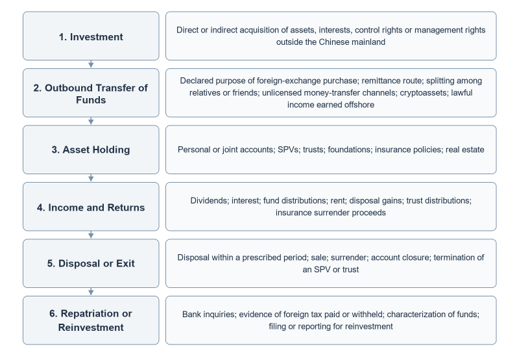
I. End-to-end oversight
Oversight may follow the full investment lifecycle rather than stop at a single remittance or account: investment inception, the outbound transfer of funds, asset holding, the receipt of income and returns, disposal or exit, and repatriation or reinvestment.
II. Look-through oversight
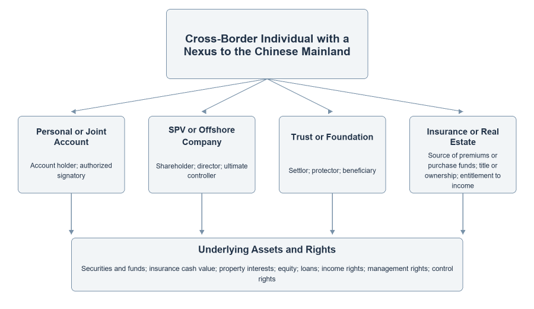
Individual outbound-investment structures may be assessed on substance as well as form. Where a cross-border individual holds assets through a personal account, special purpose vehicle (SPV), trust, foundation, insurance policy, real estate or another structure, scrutiny may extend beyond the holder of record to the source of funds, the person exercising control, the ultimate beneficial owner, arrangements governing management rights and the economic entitlement to income and returns.
III. Multidimensional oversight
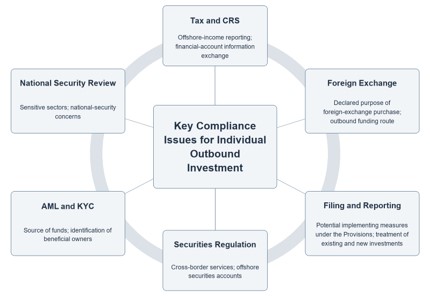
A single arrangement may engage several regulatory regimes, including foreign-exchange controls, tax, filing and reporting, bank KYC, CRS, anti-money laundering, securities regulation and outbound-investment security review.
Five Compliance Questions That Matter
Five issues deserve particular attention now that the Provisions are in force:
I. Tax reporting and data consistency: offshore income, CRS and cross-checks
Historically, cross-border individuals focused on CRS chiefly because financial-account data from outside the Chinese mainland could be exchanged with the PRC tax authorities, potentially prompting offshore-income reporting, additional tax or tax inquiries. Now that resident individuals fall within the outbound-investment framework, such data may, subject to applicable law and future implementation arrangements, be cross-checked against outbound-investment filings, foreign-exchange purchase records, bank statements in the Chinese mainland, individual income tax filings, bank KYC records, entry and exit records, identity documents and records of control over PRC enterprises. The relevant questions are not only whether information is exchanged with the PRC tax authorities, but also how it may be used to trace the source of assets, verify how funds left the Chinese mainland, characterize returns and test the consistency of reporting positions.
The tax implications may therefore become more pronounced. CRS provides an established channel for transmitting financial-account information to the PRC tax authorities. The authorities also increasingly use digital systems for tax administration, information matching and risk analysis, including cross-checking filings and conducting data-driven reviews. For individuals who remain PRC tax residents, the passage of time or the long-term holding of an account outside the Chinese mainland does not, by itself, eliminate potential exposure arising from unreported or incompletely reported income. If future implementation leads to greater coordination among outbound-investment administration, foreign-exchange records and individual income tax filings, discrepancies and risk indicators may be more readily identified.
Risk may arise less from any single data point than from inconsistencies across records held by different institutions. An individual might, for example, self-certify as a tax resident of Hong Kong SAR, Singapore or the Chinese mainland at different financial institutions, while PRC individual income tax filings omit income from outside the Chinese mainland and other records indicate continuing connections to the Chinese mainland. Unless supported by the facts and a credible explanation, such mismatches may increase the prospect of bank reviews, tax inquiries or regulatory scrutiny.
II. The USD 50,000 foreign-exchange quota is not an outbound-investment allowance
The annual facilitation quota of USD 50,000 per person for foreign-exchange purchases is not an "individual outbound-investment quota".
The facilitation quota applies to eligible current-account transactions and permitted capital-account transactions. It does not, by itself, authorize an individual to use purchased foreign exchange to acquire securities or funds, investment-oriented insurance products or real estate outside the Chinese mainland.
If an individual declares that foreign exchange is being purchased for tourism, overseas study, consultancy services, family visits or personal consumption, but the money is in fact used to acquire equities listed in Hong Kong SAR or the United States, funds or investment-oriented insurance products outside the Chinese mainland, or real estate outside the Chinese mainland, the mismatch between the stated and actual use may create a direct compliance risk when foreign-exchange declarations, bank statements, account records, CRS data and tax filings are compared.
Splitting foreign-exchange purchases among relatives or friends raises the same concern. Repeated transfers by multiple individuals through multiple accounts into the same brokerage, insurance account or investment platform may attract scrutiny from foreign-exchange and anti-money-laundering perspectives. The parties may be asked to substantiate the purpose of each transfer, ownership of the funds and the identity of the ultimate beneficial owner.
III. Legacy assets: old transactions, continuing obligations
What happens to assets already held outside the Chinese mainland? The Provisions took effect on July 1, 2026 and do not expressly provide for blanket retroactive penalties for completed investments. Conduct that violated rules already in force remains subject to those rules. If an asset was acquired using a false foreign-exchange declaration, an informal back-to-back exchange or an unlicensed underground banking channel, the relevant authorities may still address that conduct under the foreign-exchange, tax, anti-money-laundering or other rules applicable when it occurred.
A completed investment should also be distinguished from the continuing holding, management or disposal of an asset, or the continuing receipt of income or returns. The treatment of continuing holdings and other legacy assets will depend on the implementing measures and other applicable laws and regulations. Those measures may address filing, reporting, source-of-funds explanations or the registration of legacy holdings.
Legacy assets may therefore warrant different levels of review. Relevant questions include whether the funding route was lawful, whether income and returns were properly reported, whether ownership and control are documented, and whether remedial action is available under existing or future rules. Whether the implementing measures will provide a transition period, voluntary disclosure process or remediation mechanism remains open.
Legacy assets can broadly be grouped into three categories:
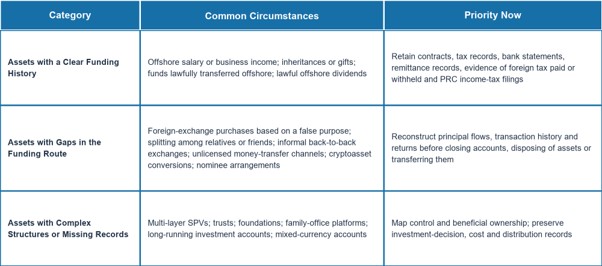
Dissolving an SPV, closing an account, terminating a trust, converting a financial-account balance into real estate or gold, or remitting funds to the Chinese mainland does not automatically eliminate historical compliance risk. Acting before the records are organized may instead break the documentary chain, increase tax costs or trigger more concentrated inquiries from banks or regulators.
IV. New investment: established channels remain relevant
The Provisions do not expressly displace established and authorized cross-border investment channels. Investments through qualified domestic institutional investor (QDII) products, including publicly offered QDII funds, Stock Connect and the Cross-boundary Wealth Management Connect Scheme in the Guangdong-Hong Kong-Macao Greater Bay Area remain governed by their respective product rules, foreign-exchange rules, investor-suitability requirements and tax-reporting obligations.
The annual facilitation quota for foreign-exchange purchases is not a freely available investment allowance. Whether the implementing measures will introduce any quota, filing or registration mechanism remains open; the Provisions themselves create no outbound-investment quota for resident individuals.
Over time, greater regulatory clarity may support compliant outbound investment. The scope and availability of lawful channels will, however, depend on the implementing measures and other applicable rules.
V. Offshore securities: the account is only part of the story
Equities listed in Hong Kong SAR or the United States, funds and exchange-traded funds (ETFs) outside the Chinese mainland, and accounts with securities firms outside the Chinese mainland are common forms of cross-border investment by individuals. Article 33 expressly addresses investment in financial markets outside the Chinese mainland. Those activities are therefore likely to be addressed in the implementing measures, but Article 33 itself does not establish an investment channel or approval mechanism for resident individuals.
The legality and compliance treatment of a particular investment depend on the applicable market-access, foreign-exchange, tax, reporting and other requirements; the location of the account alone is not determinative. The ability to open an account or execute a trade is not the legal test. The more important questions are how the account was opened and funded, whether income and returns were properly reported, and whether an eventual exit or repatriation can be managed under the applicable framework.
Much of the regulatory attention to date has focused on service providers: securities firms and other institutions outside the Chinese mainland conducting cross-border business with investors in the Chinese mainland, soliciting or referring clients onshore to open accounts outside the Chinese mainland, or carrying out onshore marketing and client-service activities. The Provisions also place resident individuals expressly within the outbound-investment framework. Compliance by service providers, together with scrutiny of investors' funding routes, reporting of returns and investment conduct, may jointly shape the analysis going forward.
The Provisions do not, by themselves, require holders of existing securities or fund accounts outside the Chinese mainland to liquidate positions, close accounts or move assets. A prudent immediate response is to review account-opening records, KYC documents, CRS self-certifications, funding records, transaction histories, income and return records, evidence of foreign tax paid or withheld, and PRC tax filings. The longer an account has been used for rolling investments, the more likely it is that principal, returns, reinvested returns and currency-conversion records have become commingled, increasing the cost and complexity of any review or remediation.
How the Rules Could Affect Common Cross-Border Assets
The Provisions do not, by themselves, end cross-border asset allocation or the use of structures outside the Chinese mainland. They do, however, make it more important for resident individuals to understand the investment features of particular products, the applicable funding rules and the legitimate functions of cross-border structures.
I. Insurance issued outside the Chinese mainland
Insurance products issued outside the Chinese mainland differ materially. Protection-oriented products, including term life, medical and critical-illness insurance, primarily serve protection and succession purposes. Savings policies, annuities, participating policies, high-cash-value policies and policy-financing arrangements often have investment, cash-flow and asset-allocation features as well, and may therefore attract greater regulatory attention. The economic characterization of a policy does not, by itself, determine whether a premium payment or funding route is permitted under PRC foreign-exchange rules.
For products with investment features, large premium payments, policy loans, surrender, policy dividends, repatriation of returns or assignments of policy rights may prompt requests for evidence of the source of funds, investment purpose, nature of the returns, foreign tax paid or withheld, and the status of any required PRC reporting.
Insurance issued outside the Chinese mainland can serve protection, succession and cash-flow planning, but it should not be treated as a vehicle for obscuring investments. Where premiums were historically paid through informal or non-transparent channels, surrender, a policy loan, a change of beneficiary or repatriation may prompt questions about the source of funds, the nature of returns and whether applicable tax has been paid.
II. Residential property outside the Chinese mainland
Whether property is owner-occupied or held for investment may affect the tax and risk analysis, but it does not, by itself, determine its treatment under outbound-investment or foreign-exchange rules. In either case, the acquisition requires a lawful funding route. Property held for rent, resale or portfolio allocation raises additional questions concerning income, gains and reporting.
For investment property, the analysis also extends to rental income, disposal gains, foreign tax paid, PRC income tax reporting, repatriation and reinvestment.
Real estate is not a financial account, and CRS primarily covers financial-account information. But converting a financial-account balance into property does not erase the funding history. The source of the purchase money, reporting of rental income, treatment of disposal gains and eventual repatriation of sale proceeds may still be examined through tax filings, bank inquiries and the tracing of fund flows. Property ownership does not, by itself, eliminate the relevance of information exchange, tax reporting or outbound-investment rules.
III. SPVs, trusts, foundations and family offices
SPVs, companies outside the Chinese mainland, family trusts, private foundations and family offices may serve legitimate functions in cross-border shareholding, financing, investment governance, risk segregation, succession, family governance and long-term asset management. Tax regimes and fund or family-office frameworks in some jurisdictions may also serve their intended purposes when the relevant conditions are met.
What should be reassessed is the expectation that multiple layers, differences among jurisdictions, nominee relationships or information gaps can provide concealment. Under a substance-based or look-through analysis, competent authorities may examine not only legal form, but also who supplied the funds, who exercises control, who receives the economic benefit, who makes investment decisions and whether the structure has genuine commercial, succession or governance functions.
These structures remain valid tools, but they should not be expected to conceal funds, circumvent disclosure, shift returns without a legal basis or cure a defective funding history. Their legitimate functions include compliant management, succession planning, asset segregation and investment facilitation.
The Cost of Non-Compliance
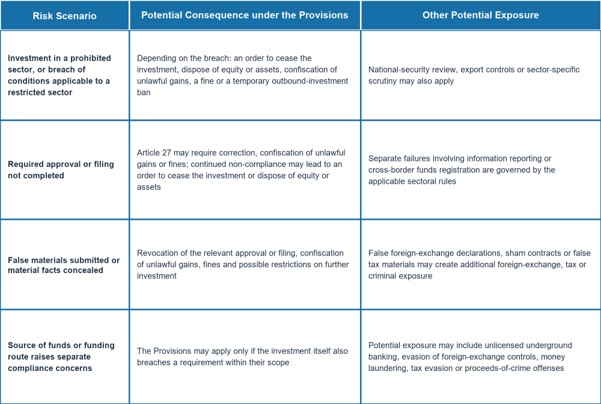
Articles 27 to 29 of the Provisions provide for different administrative consequences depending on the nature of the violation. These may include, as applicable, an order to cease the investment or dispose of equity or assets, confiscation of unlawful gains, fines, temporary refusal to accept approval or filing applications, or a temporary prohibition on outbound investment. Two consequences deserve particular attention:
First, confiscation of unlawful gains. The term "unlawful gains" does not, on its face, mean that the entire amount invested will necessarily be confiscated. Its scope will depend on the applicable legal basis, the facts and the determination of the competent authority. In a long-running account outside the Chinese mainland, principal, returns, reinvested returns, inter-account transfers, currency conversions and reinvested dividends may be commingled. If the investor cannot substantiate the source of funds, acquisition cost, transaction history, foreign tax paid or withheld, and the nature of returns, distinguishing principal from gains may be difficult.
Second, disposal within a prescribed period. Selling listed securities may be relatively straightforward. A time-limited disposal of unlisted equity, SPV interests, trust interests, family-fund units, real estate outside the Chinese mainland or other illiquid assets may produce valuation discounts, tax costs and contractual breaches.
Liability under the Provisions arises primarily within the outbound-investment framework. If tracing the funding route uncovers unlicensed underground banking, informal back-to-back foreign-exchange arrangements, sham contracts, tax-evasion proceeds or other proceeds of crime, separate exposure may arise under foreign-exchange, tax, anti-money-laundering and criminal laws. Conduct that constitutes an offense may be prosecuted in accordance with law.
The following examples are illustrative; the applicable consequences depend on the facts and legal basis:
Residency and Status: Common Misconceptions
I. Residency is a legal test, not a document label
The implementing measures have not yet defined "resident individuals in China". It would therefore be premature to assume that the concept will follow the tests used under tax or foreign-exchange rules. It remains to be seen whether the definition will refer to nationality, household registration, identity documents, habitual residence, economic interests or other factors.
Terms such as "resident individual," "domestic individual" and "tax resident" do not carry identical meanings across every body of law. A person's status under PRC tax law, foreign-exchange rules and future outbound-investment measures should therefore be assessed separately unless the implementing measures expressly cross-refer to an existing definition.
Tax residence illustrates the point. Holding Hong Kong SAR residency status, Singapore permanent residence or an Employment Pass, permanent residence in another jurisdiction, a long-term visa or a bank account outside the Chinese mainland does not, by itself, exclude PRC tax residence. Under the PRC Individual Income Tax Law, an individual is a PRC tax resident if the individual is regarded as having a domicile in the Chinese mainland because of household registration, family ties or economic interests or, if not domiciled there, is present in the Chinese mainland for 183 days or more in a tax year. Status for foreign-exchange and outbound-investment purposes requires a separate analysis.
In practice, some recently relocated individuals have obtained residency status outside the Chinese mainland while their lives, families, business management, funding sources and main economic interests remain closely connected to it. Inconsistencies among identity documents, actual residence, funding facts and reporting positions may surface in later bank reviews, tax inquiries or regulatory scrutiny. Readers focused on Hong Kong SAR residency may also refer to "Hong Kong SAR Residency: Ten Compliance Questions, from Visa Renewal and Permanent Residence to Tax Residence and Cross-Border Accounts ".
II. Residency planning: substance over labels
For legacy assets, a change in residence or legal status does not cure pre-existing compliance risk. If funds left the Chinese mainland through a non-compliant route while the individual was resident there, or if earlier years involved unreported income from outside the Chinese mainland, inconsistent CRS self-certifications or a mismatch between the declared and actual use of foreign exchange, later obtaining residency elsewhere or deregistering a PRC household registration does not erase those facts.
For future investment, the Provisions should not be read as a reason to "change status quickly," or as suggesting that relinquishing a status eliminates compliance obligations. A cross-border individual who already has residency outside the Chinese mainland should first assess whether the underlying facts and reporting positions are aligned: actual residence, family arrangements, source of funds, place of investment decision-making, bank KYC records, CRS self-certifications and tax filings.
Sound long-term planning should follow substance. Cross-border individuals should consider where they actually live, whether their family and center of main economic interests have moved, where assets are managed and investment decisions are made, and how tax consequences compare with the practical availability of lawful outbound-investment channels. Those who genuinely intend to live, work and manage assets outside the Chinese mainland over the long term can align residence planning with compliant funding routes, tax-reporting obligations, investment structures and actual asset-management arrangements. For individuals who remain closely connected with the Chinese mainland, obtaining residency elsewhere may not, by itself, alter applicable obligations; the outcome will depend on the definition adopted in the implementing measures and other applicable rules.
What to Watch, and What to Do Now
As of July 20, 2026, no specific measures governing outbound investment by resident individuals had been publicly issued. Key questions include how legacy assets will be treated; whether there will be a transition period, voluntary disclosure process or remediation mechanism; how "resident individuals in China" will be defined; whether new investment will be subject to filing, reporting, quotas, source-of-funds requirements or other procedures; and whether the rules will differ by asset class.
Compliance considerations are now part of the economics of cross-border asset allocation. Investors will need to weigh not only returns, currency exposure, ease of account operation and structural costs, but also residence, tax, reporting obligations, funding routes, structural maintenance and the compliance costs of eventual exit and repatriation.
Three steps can be taken now:
First, inventory existing cross-border assets and structures. For accounts, securities, funds, insurance policies, real estate, SPVs, trusts, foundations and family-office arrangements, identify who holds, controls and benefits from each asset; where the money came from; how returns are distributed; and whether the structure still serves a genuine commercial, succession or governance purpose. Nominee arrangements, structures that conceal actual control, and long-term accumulations of undistributed returns without a commercial rationale should be assessed early for appropriate compliance adjustments.
Second, build the documentary trail. A future filing, report, bank inquiry, repatriation or restructuring may require evidence of the source of funds, investment purpose, nature of returns and foreign tax paid or withheld. Contracts, bank statements, fund-flow records, transaction histories, tax records and structural documents should be organized so that they corroborate one another.
Third, reassess structures and residence planning with compliance costs in mind. Individuals who intend to live, work and manage assets outside the Chinese mainland over the long term should consider whether the tax consequences, availability of lawful outbound-investment channels, source of funds and actual residence support the proposed arrangement. Changes should not be made solely in an attempt to avoid the application of the Provisions.
Conclusion
The Provisions mark a milestone in the regulation of outbound investment by resident individuals. Stronger oversight does not necessarily mean less room for compliant cross-border investment. The Provisions seek to advance the high-quality development of outbound investment while strengthening effective regulatory oversight and protecting investors' legitimate rights and interests. Greater regulatory clarity may, over time, provide more predictable conditions for compliant, transparent and sustainable cross-border investment.
Individuals and families who already hold, or plan to acquire, assets outside the Chinese mainland should understand the applicable rules and assess the associated risks and costs before making or modifying their investment arrangements.
Important Announcement |
|
This Legal Commentary has been prepared for clients and professional associates of Han Kun Law Offices. Whilst every effort has been made to ensure accuracy, no responsibility can be accepted for errors and omissions, however caused. The information contained in this publication should not be relied on as legal advice and should not be regarded as a substitute for detailed advice in individual cases. If you have any questions regarding this publication, please contact: |
|
Huiyi SONG Tel: +852 6486 0307 Email: huiyi.song@hankunlaw.com |
|
Lan YU Tel: +65 9839 8208 Email: lan.yu@hankunlaw.com |


